Icon Diploma Student

Learning to see with the eye of the heart

A Glimpse Behind the Scenes (Part One of Two)

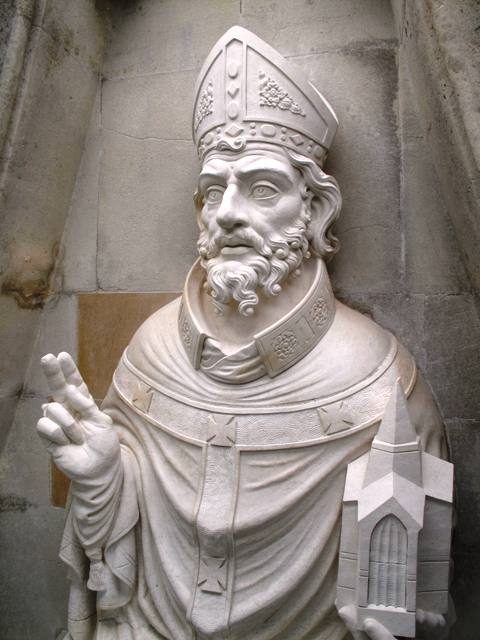
New sculpture of St Peter of York

The Eyes of St Peter of York

Hello icon friends

Part One: York Minster – a Glimpse Behind the Scenes

This is a step away from my usual posts. However, if you would like to take an armchair trip with me first to York Minster then, in part 2,  to the creative heart of Shropshire, then fill up your mug and join me here for the next few minutes. I have included links to websites with more in-depth articles; these will give you a much richer picture of the scope of what is going on. I have also tried to include photos of parts that are otherwise out of sight to give you a feel of our visit.

An offer not to be refused
An invitation by Andrew Arrol  Surveyor for the Fabric of York Minster, to see work in progress is a rare and privileged opportunity and certainly one to be accepted and shared.

View from the top of the east end of York Minster

The recently landscaped south entrance, viewed from the top of the east end of York Minster

As a former York resident, I recall the Minster being shrouded in scaffolding throughout my childhood. For years the residents only had glimpses of the mysterious work going on behind the hoardings. So, for me to be able to witness work at close quarters was a real joy and I was delighted that Martin Earle (fellow icon student) and his fiancee Katherine, could join me. Martin is working with Aidan Hart on the sculpture of Our Lady of Lincoln as I write, (more on this in part 2).

There is a much more open approach to the conservation work at the Minster and educational visits form part of Andrew’s remit. For an overview of what is going on with the works, click on York Minster.
One of our hopes for the visit was to see the newly carved St Peter, recently installed above the Great East Window. The original figure had been dismantled and studied although the severe erosion of the features meant a great deal of research before the new face of St Peter could be formed. The existing figure had been carefully analysed so that when the new figure was in place, it would include the same foreshortening of the figure to correct the view from the ground.

The original St Peter

The original St Peter badly worn by weather erosion

To give you an idea of where St Peter has been located – it is not far from the top of the lift shaft.

Martin and Katherine standing at the foot of the East end of

Martin and Katherine standing at the foot of the East End of York Minster

The new St Peter is a magnificent work of art, a seated figure of over six feet. An extract from York Minster’s weblink below reads: ‘It has been designed by Martin Coward of York Minster’s Stoneyard, who created scale models in clay, before a full size version of the approved design was sculpted and cast in plaster of Paris.  Martin is carving the top section of the figure, including the detailed head’.

The new stone figure of St Peter, in place above the east window.

The new stone figure of St Peter, in place above the east window.

There is a full description of the work behind St Peter on York Minster Revealed

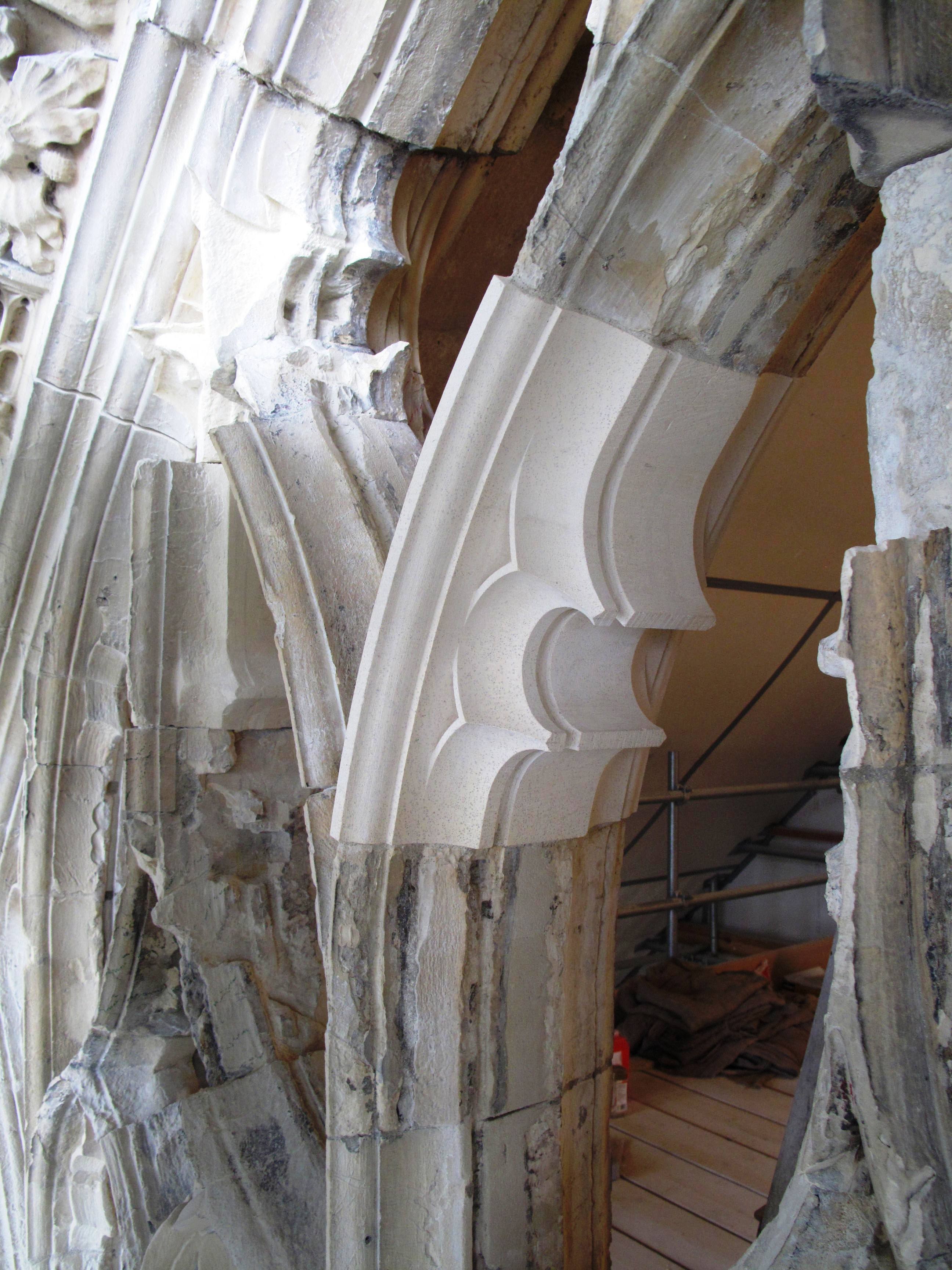
New stonework indented into existing window arches

New stonework indented into existing window arches

Every stone has been surveyed and great care has been taken to maintain as much of the old masonry as possible. Each stone is assessed according to its exposure and position as to whether it can last well into the next century and replaced only if necessary.

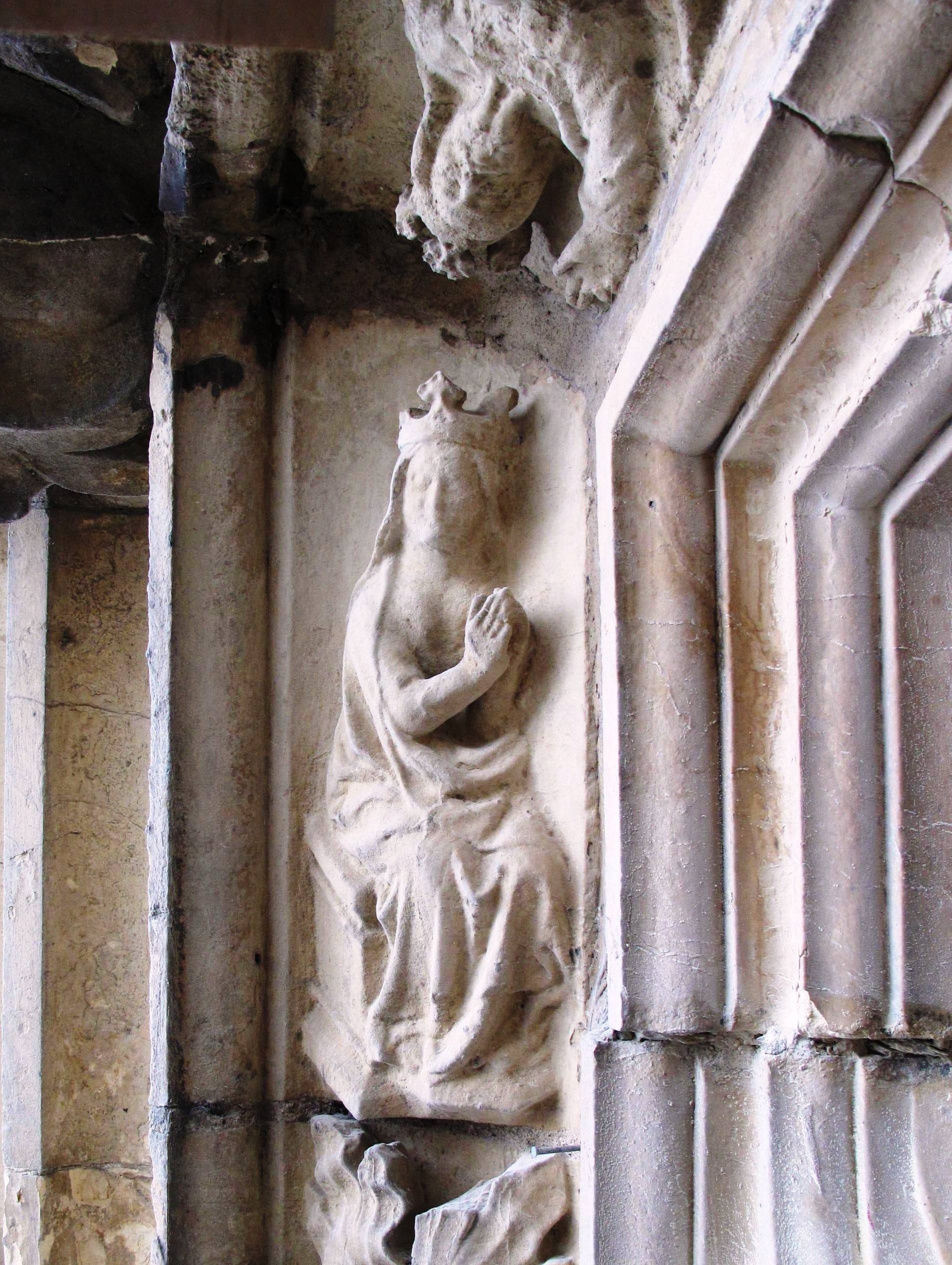
Queen of Heaven

Queen of Heaven

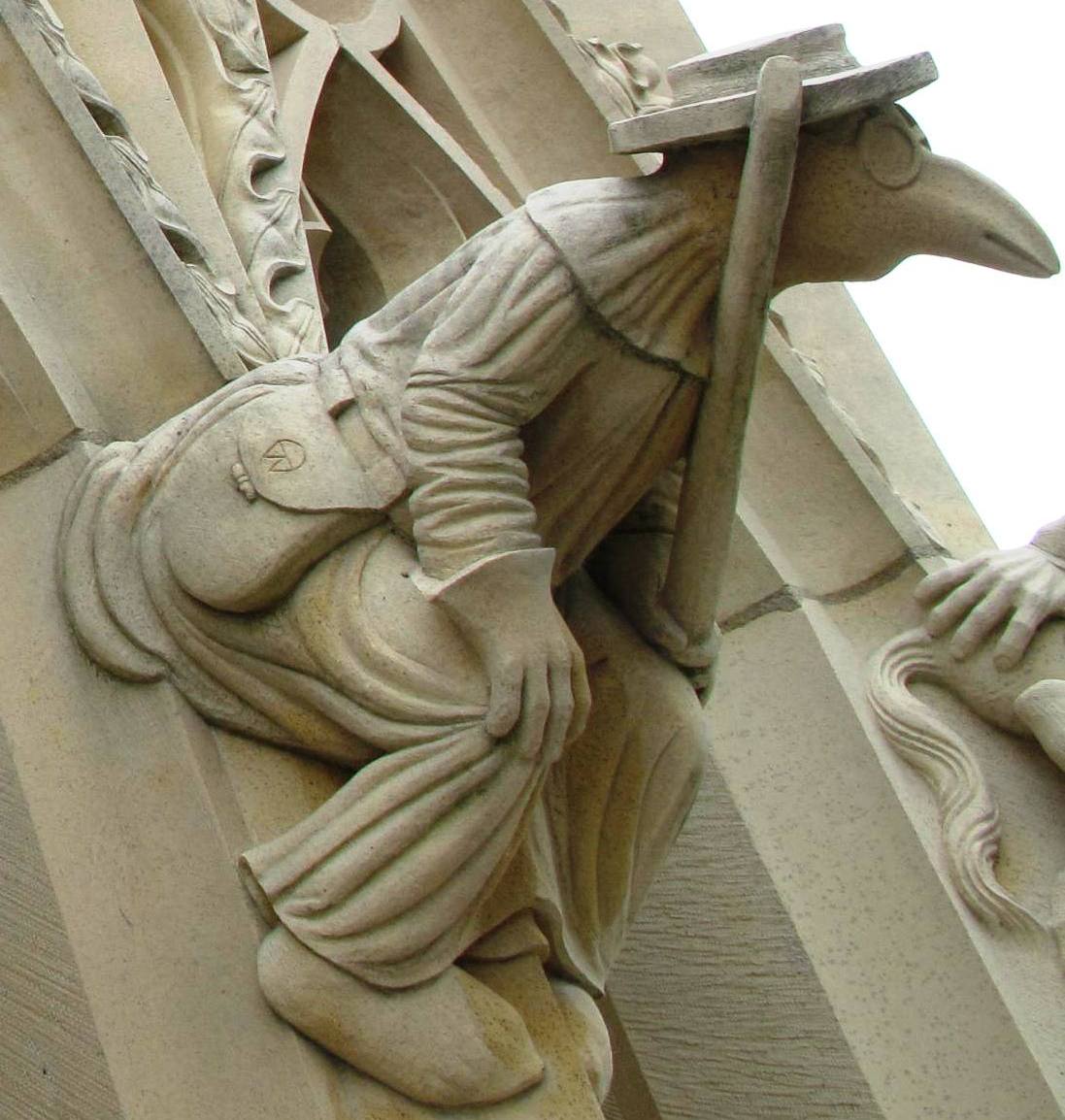
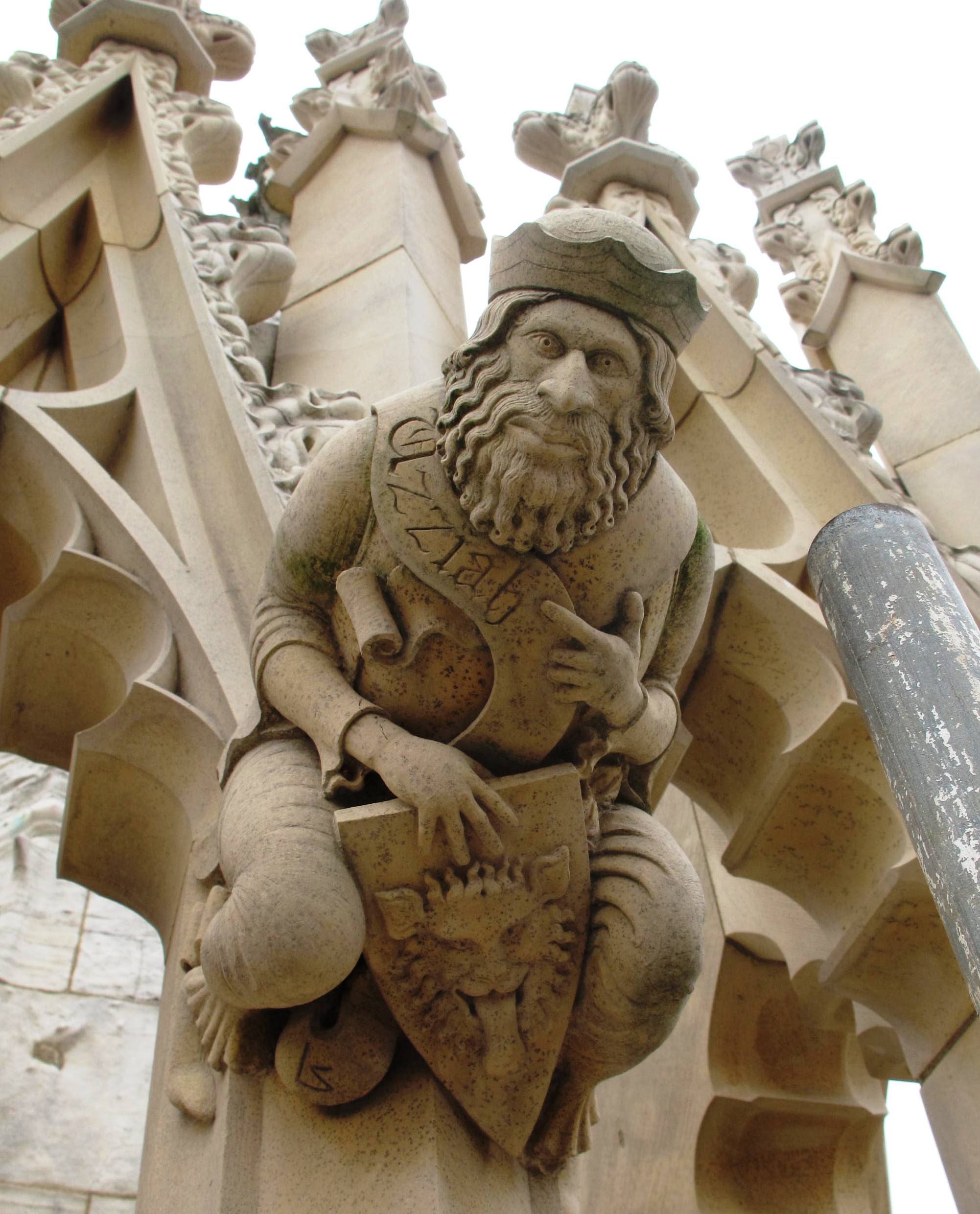
There is a wonderful creative spirit with the stonemasons as they have been free to design the images that grace the uppermost parts of the building. Most of these will never be seen from the ground so here are a few birds eye views:

A tiny figure clings on to the tracery

A tiny figure clings on to the tracery

Plague Doctor carving

The Plague Doctor

Uzziah

Uzziah

Now taking you swiftly down from the heights to the very bottom of the building and into the crypt, to find the medieval stone carving of the Virgin of York, a subject very dear to both Martin and Aidans’ hearts, but more about that in my next post.

Virgin of york Minster

Virgin of York Minster

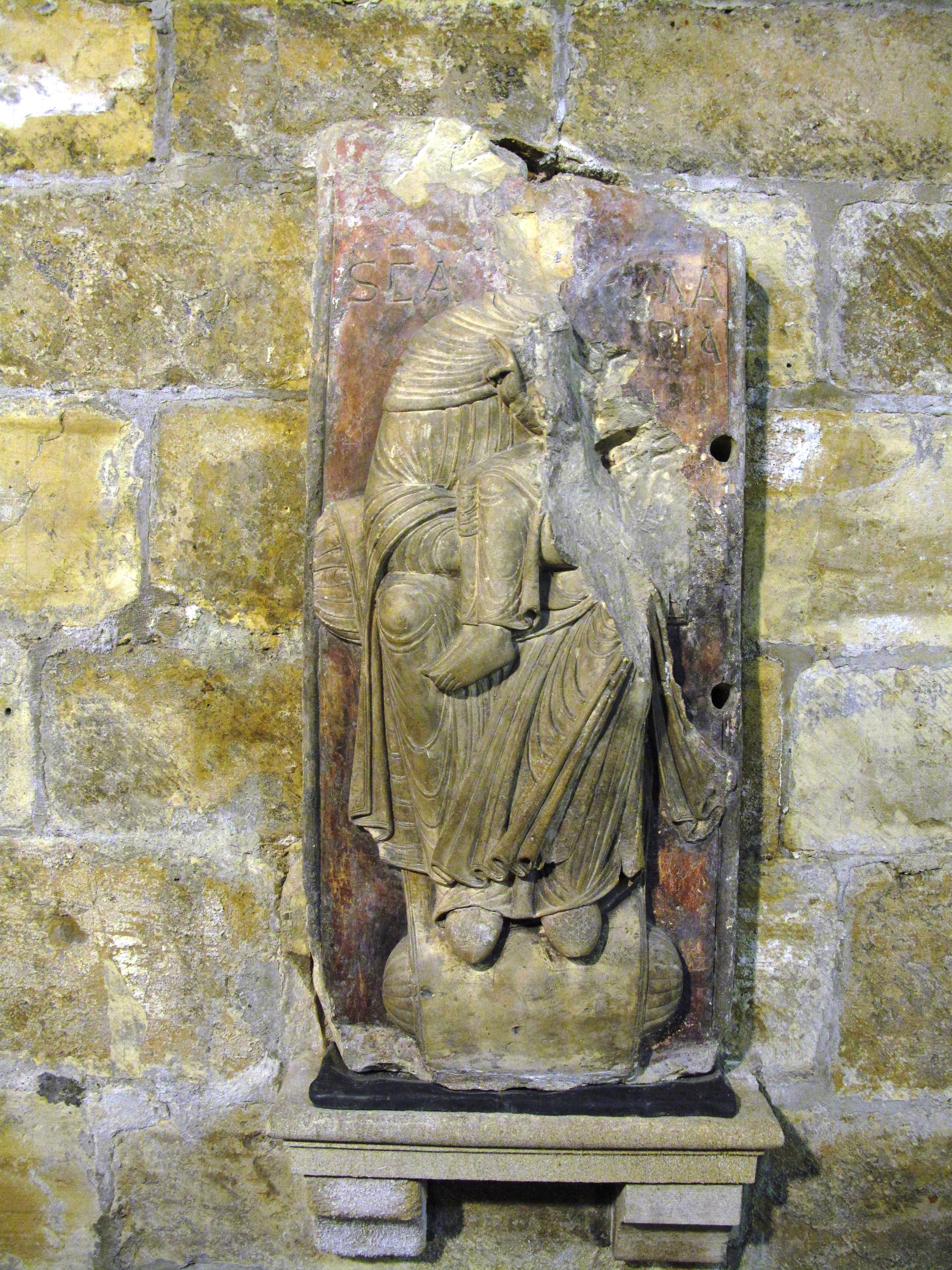
The inscription reads ‘SCA MARIa’ Saint Mary. Mary holds the infant whose hand is raised in blessing. Much is still to be discovered about this image such as the type of stone it has been carved from and the exact date. The scuplture is Romanesque in style with Byzantine influence and it is considered to be from around the 12th Century.  The damage could have been as a result of the 16th century iconoclasm or ocurred during the course of past building works. It was discovered in 1829 after a fire broke out in the Quire.

The Stone Masons at work in York  Minster

The stone masons at work in York Minster

There is so much more I could write about our visit such as the beautiful woodwork in the Chapter House, the repair work to the stained glass of the Great East window, more on the stone repairs and so on, but I want to pause here to acknowledge the masons. They are in a league of their own – master craftsmen and craftswomen par excellence!

To Andrew Arrol and your team – thank you so much for a truly memorable visit.


Hello icon friends,
Good to be back to share what has been going on this last month. I set Gabriel to one side to for a short while to make way for the Prophet Moses – homework time!


Moses detail

Moses detail

Now that we have our first six months behind us, there are signs of all our efforts beginning to bear fruit. It was wonderful to see over 24 homework studies from 12 students all laid out together, they made quite an impact. Let me tell you a little about this particular example
I have tried a different mix of pigments for young Moses: French Ochre Sahara and Avana (75% – 25%) just to explore a different colour. Aidan had said that each colour has a personality, some are more translucent or gritty and it is good to get to know their qualities.
 

Moses pencil outline

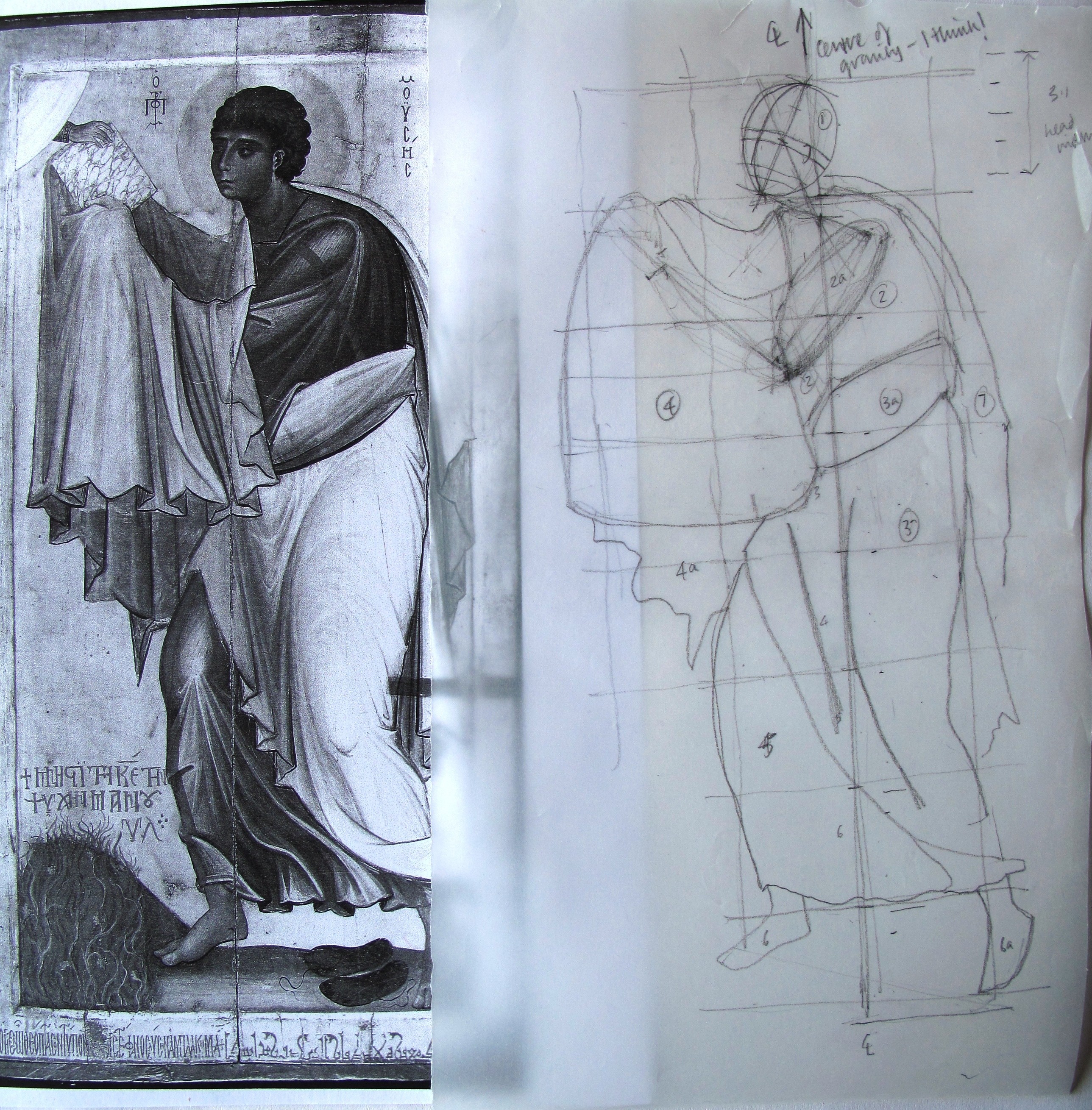
Icon of Moses, St Catherine’s Monastery, Sinai with sketch pencil outline to identify key forms

Aidan reminds us that when we start out, we should spend some time studying the icon before we begin to sketch. Look for the dominant movement, the centre of gravity, the direction that the body takes, the qualities that the person is portraying. Icons start with spiritual truths which are then expressed in matter. Study the main forms and don’t worry about the detail just yet. Is it dynamic or still? Check the proportions of the body in relation to the head, use your dividers to check relationships.

Spending time pencilling out the form on tracing paper helps me to identify some of these points. First I drew the centre of gravity then outlines around the main forms. I drew an axis on the head and divided the vertical line into head lengths. I found the array of garments a little perplexing to draw without some help so I drew a head-sized, free-hand grid either side of the vertical line.

Pencil sketch of Moses

Pencil sketch of Moses

The figure seems quite top heavy, but the whole image is balanced by the burning bush at the bottom. Once I was more familiar with the form, I was ready to set Moses out on my watercolour paper. I allowed 2cm for a border then divided the given area into 9 head lengths which allows for halo space and ground (approx. a head length).

Light wash over pencil outline

Light wash over pencil outline

I’ve learned that it is best to start with a very light wash over the main forms, then rub out the pencil before the drawing gets muddy. This is also the time to look again at the main areas of light and shade, look at which parts of the figure are nearest the viewer (the lightest) and which recede (the darkest).

I will leave you with my final piece and once again, thanks for reading!

Moses study complete

Moses study complete


Gabriel at Large

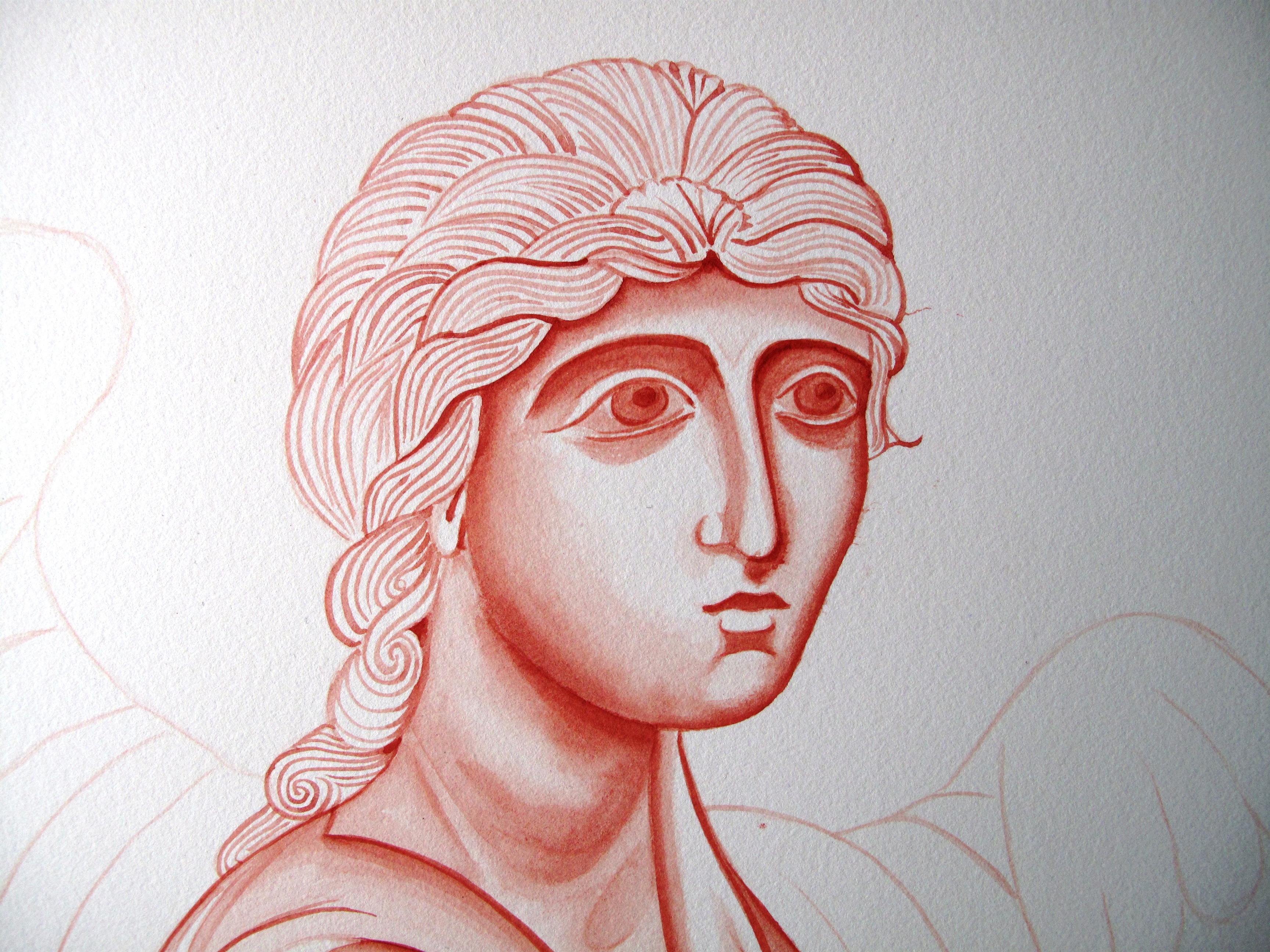
Gabriels face appears

Gabriels face taking shape

Hello again icon friends,

The image above represents a quick sidestep past another effort which ended up in the experience bin. I had started this stage quite pleased with my decision to stretch myself by working on a larger image. I transferred the outline of my final drawing of Gabriel on to A2 sized paper which gave Gabriel the space to outstretched his arm in full.

Transferring the final drawing

Transferring the final drawing on to unstretched A2 Fabriano Artistico watercolour paper

On went the image using a sheet of paper which I had rubbed with Armenian red bole (a red pigment) to act as transfer paper. Then I painted lightly over these lines to fix them.

Painting on the outline

Painting the outline on to the paper

So far so good. However, as I washed over the larger areas, the paper began to cockle.

Image of Gabriel 1

Image of Gabriel 1

I then got caught up concentrating on the face rather than building up the image lightly and evenly as a whole. I looked at the face in comparison with the original and decided I had gone so far adrift that it was only paper and I should start again, and start properly. I am sparing you a larger image of my first Gabriel who looks rather stern!

Gabriel looking nothing like the original!

Gabriel looking nothing like the original!

So, down to the DIY shop to buy an MDF board cut a little bigger than A2, together with some water colour tape and this time soak the paper in the bath for a few minutes, tape it to the board and let it dry. By this stage I had had enough, so I left the board and wet taped paper flat on the floor overnight and by morning it was dry and had stretched beautifully!

Gabriel with a softer face

Gabriel with a softer face

This time, I tried to develop the whole figure and garments at the same time. There are numerous mistakes with the garment folds which I realised as soon as we got the handouts on our next Icon session but at least I can see where I have gone adrift.

I have attached Aidan’s handout notes on painting standing figures and garments if you would like to find out more on this subject. I am concentrating on our homework for the time being but will come back to Gabriel in a few more weeks.

Day 7 Aidan Hart’s handout on standing figures 24 Feb 14

Adding shading to define the forms

Adding shading to define the forms

Gabriel underway

Gabriel set on the A2 paper

Thanks for reading!

Meet my mistakes!

Annunciation of Ustyug, Novgorod, 12th Century

Annunciation of Ustyug, Novgorod, 12th Century

Hello icon friends,

It is one thing hearing how to do something and another altogether applying it via the end of a brush or pencil. I set out to try another upper body monochrome of the Archangel Gabriel from the beautiful image of the Annunciation above and in the course of this I have befriended a whole group of mistakes – let me introduce a few!

I lightly sketched out the image ready to paint over but saw immediately that I had run into difficulties. First of all, I didn’t get the overall composition right.

Preliminary sketch of Gabriel

Preliminary sketch of Gabriel

I had set out the upper body study on A3 paper but in doing so found I had cut off the hand. This seemed to lose the whole point as the hands are so expressive of the whole message that the image contains. Looking at it now, for this exercise I should have zoomed in and concentrated on the face and upper arm, but I had started so I carried on.

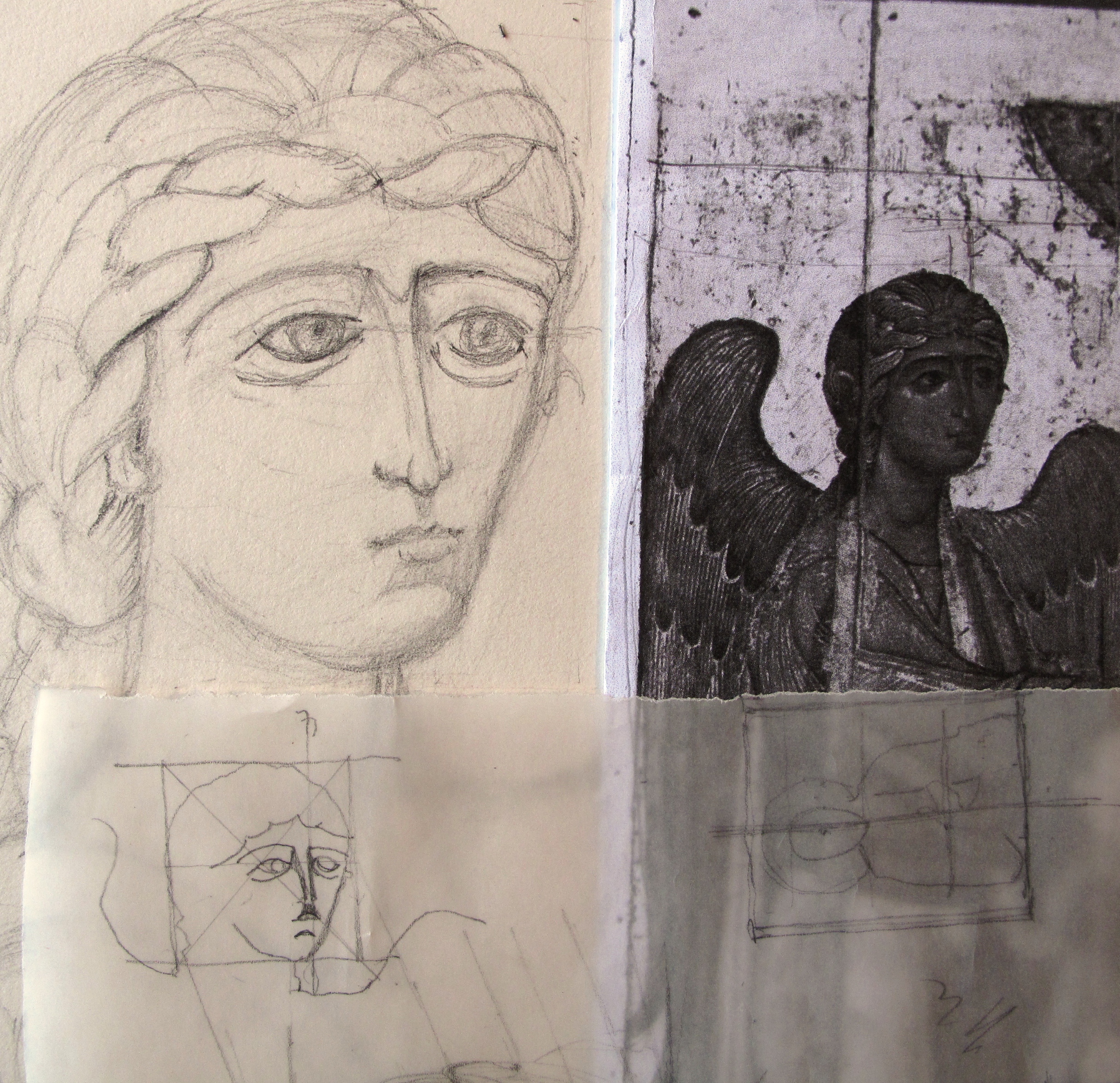
Sketch comparisons

Sketch comparisons, finding the centret to identify where I am going adrift

Secondly, I couldn’t get the face, in particular the eyes, quite right.  I did a cross check between the original and my drawing by forming a simple square to enclose the head, then joined the diagonals to find the centre point of reference. I was pleased to see that the point landed in exactly the same spot on my drawing, but it showed immediately where the rest of the face had gone astray. The nose leant too far over and the eyebrows had fallen down.

Adjusting the features but there is still something not right

Adjusting the features but there is still something not right – the eye on the right and the tilt of the head?

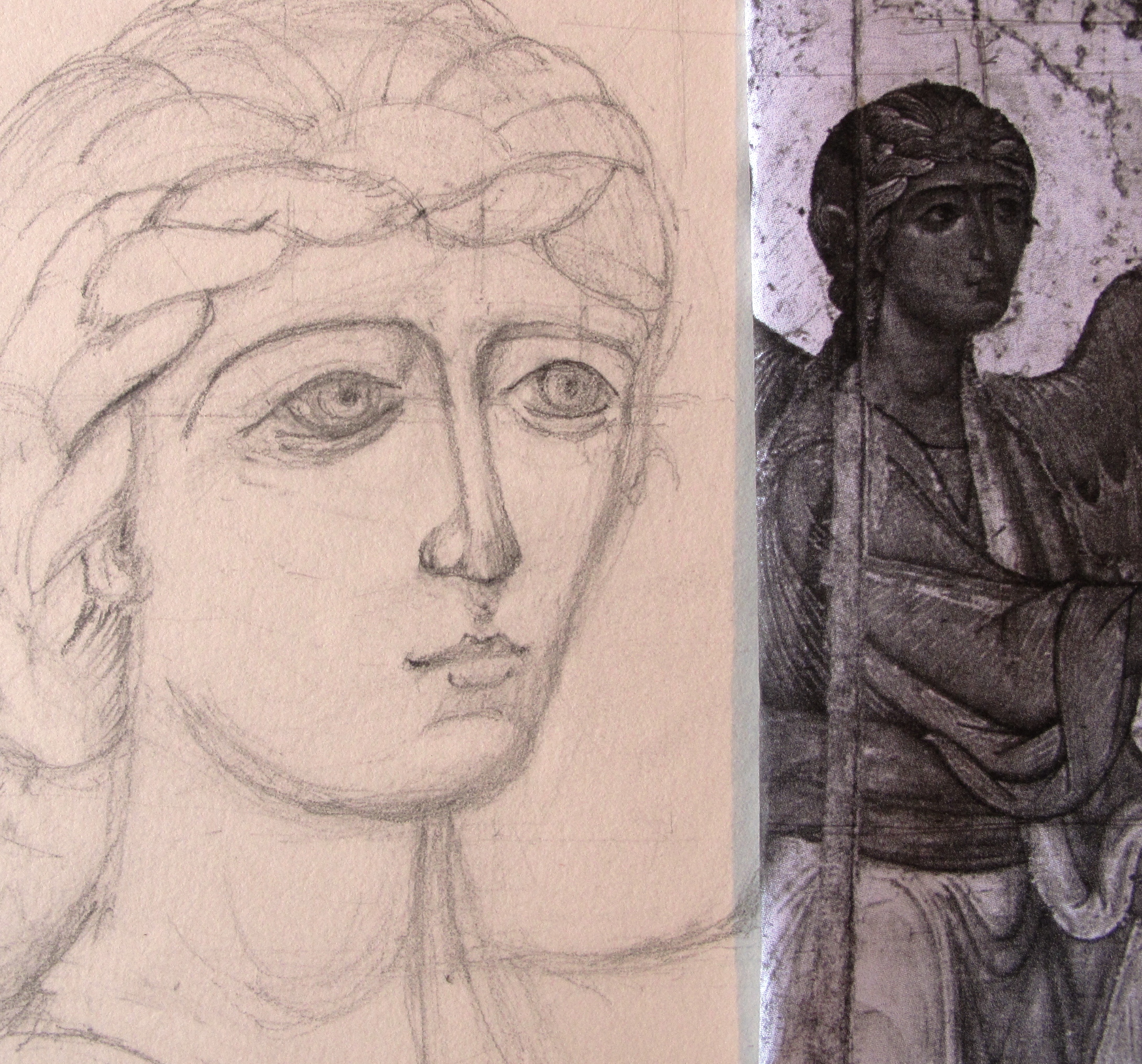
After a few days away from this drawing, I still couldn’t quite see where they were going adrift so I traced over the original eyes to clarify their shape and laid them over my drawing.

Tracing the profile of the originals to identify where I am going wrong

Tracing the profile of the original eyes to identify where I am going wrong

One slight move of of one feature has repercussions elsewhere so the brows, nose, mouth, cheek profile all got adjusted and brought into alignment. I suppose that speaks on another level too, to always go back to the source to bring something of ourselves that is out of step back into alignment.

The eyes on the left after being adjusted.

The eyes on the left after being adjusted.

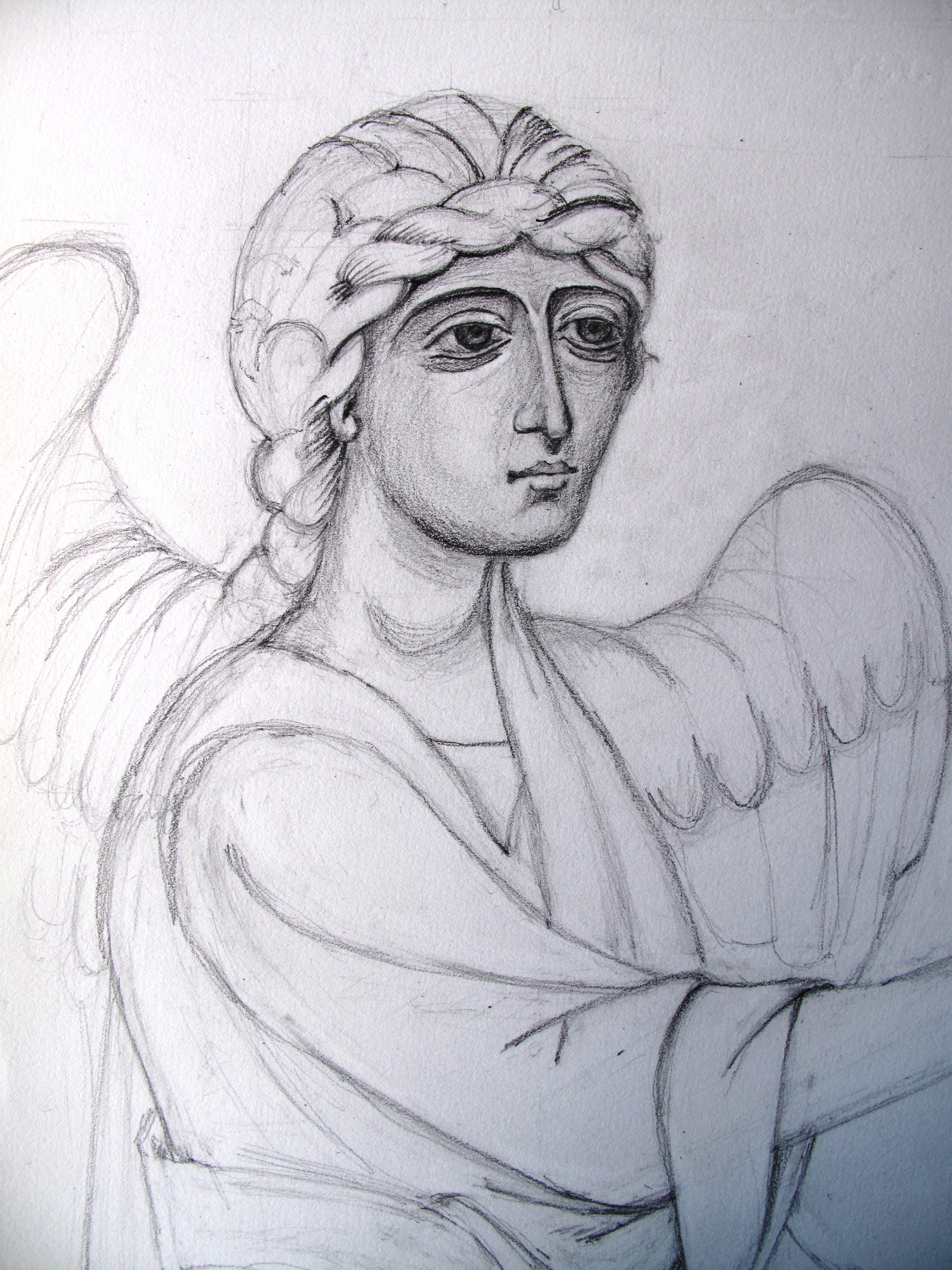
Sketch of Gabriel near completion

Sketch of Gabriel near completion

With all the rubbing out and rearranging I had made quite a mess of my paper. I thought hard about all that I had learnt and decided that I would take a bit of a leap and redo the whole image again but on larger paper. So, next time I will tell you about how I made a fresh crop of mistakes as I move onto A2 paper. Thanks for reading!

Lofty Discoveries!

Hello Icon Friends,

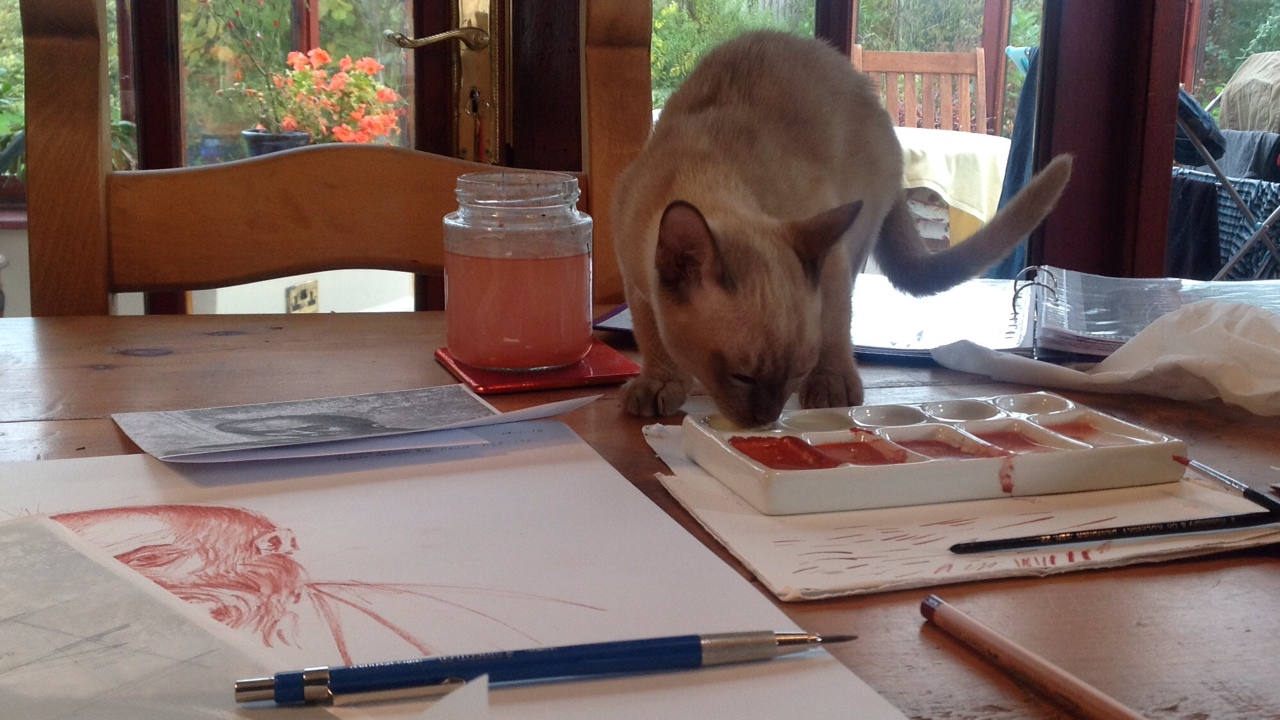
I am making up for time lost last week when I was out tying ‘Missing’ posters to lamp posts and scouring the internet for our pet cat. Not the little fellow you might have seen eating up my egg mix in November, but our older cat Ollie. Two nights away is unheard of for this home-loving creature. A long story cut short, we now have new friends down the road and if you lose a pet, enlist St Francis and put up posters! Ollie had climbed into their loft space where they were building an extension and got stuck. I am overjoyed to have her home and very thankful to St Francis!

So, back to the paper trial. The Saunders paper is without a doubt a treat to work on but having tried the Fabriano Artistico, I have to say that I found blending the egg tempera just a little bit easier. The paper is almost luminous and seems to make St John more appear more present.

Monochrome study of St John the Evangelist

Monochrome study of St John the Evangelist

Looking back on my posts, I have spared you my earlier image of St John. This will never do! I should be showing you how my work is hopefully progressing.

Why is it we always see things (where we have gone wrong) more clearly when we take a step back?

Why is it we always see things (where we have gone wrong) more clearly when we take a step back?

Let’s see, St John above is my most recent work, on Fabriano Artistico paper.  St John below was painted on rough white water colour paper, about 2 months ago.

Blending the paint is clumsy and the overall appearance is hard. See my post 'Core, Clarity and Confidence'.

Blending the paint is clumsy and the overall appearance is hard. See my post ‘Core, Clarity and Confidence’.

It has taken a few attempts and I am still a long way off, but I think the blending above is getting a bit softer. That said, looking at the uppermost one as I write, his whole head shape is still too round, the shape of his face too wide and flat, the eyes looking too much to the left…oh…I am going to have to have another go!

Homework update from the icon course day five: Day 5 Notes Icon Screens Day 5 26th November 2013 Feet

Before I say cheerio, here are five more quotes from “the mustard seed garden Manual of Painting” to follow from the last blog post:

Originality should not disregard the ‘Li’ (the principle or essence) of things

Learn from the Masters but avoid their faults

Posess delicacy of skill with vigour of execution

The second fault is described as ‘carving’ (‘K’o) referring to the laboured movement of the brush caused by hesitation. Heart and hand are not in accord. In drawing, the brush is awkward.

He who is learning to paint must first learn to still his heart, thus to clarify his understanding and increase his wisdom.

The Spirit Gives Life

Warm greetings Icon Friends,

I have tried some different paper for my monochrome studies and I think it has made all the difference! I would love to know what you think. The study on the left is the second (fourth if you count pastel studies) attempt at painting the Virgin standing at the foot of the cross.

Image

So far, I have been using a rough surface, bright white paper for my monochrome studies and not been doing very well with blending the egg tempera. A fellow icon student suggested I try using a heavy weight (300gsm) hot pressed watercolour paper such as Fabriano Artistico or Saunders Waterford. Both are smooth, creamy coloured and gorgeous to work on, though with a slightly different texture. I have done a monochrome on both these papers to compare them.

I started with the Saunders paper and it was so much smoother to work on than the rough white watercolour paper. The paint flowed and blended without having to saturate the paper with water first although I did apply a light water wash before addressing a large area. I am gradually finding my way around the end of a paint brush – it really is a case of just getting on with it and learning as you go along. Aidan makes it look so easy but it isn’t!

The blending and overall appearance of this monochrome looks a bit better than my earlier attempt a few months ago. I have attached the work in progress photos as a pdf. The folds in the robes still have a long way to go though!Virgin at Foot of the Cross

I have finished writing up my notes and will attach them in stages. Day 4 Proportions of hands Ottoman Romanesque Carolingian examples

Next post will be about the Fabriano paper.

Thanks for reading and I will leave you with:

The seven canons


The Spirit gives life


The brush’s task is to incarnate spirit


Although you abstract, model form

According to the essential laws of nature


Usecolour to manifest the spirit


Organize the elements within the panel

To make an harmonious world


Remember there is an imperfect perfection

And a perfect imperfection


In copying, seek to unearth

The master’s techniques

Core, Clarity and Confidence

Hello icon friends and a very happy New Year to you all!

It seems a long time since I posted my ‘Holy Noses’ but Christmas was particularly joyful this year with much to celebrate and be thankful for. I like to start the New Year with a big early spring clean whilst thinking about what I would like to make room for in the coming year before settling back into painting.

When Aidan reviewed my sketches of the Holy Noses, one thing was quite apparent – my brush strokes lacked confidence. Looking back at them now, they are quite spikey, and they go off in different directions. Not to worry, I heard someone on the radio say “I learned so much from my mistakes in life, I wish I had made more!”

After some reflection, I will keep one word to the forefront this year: ‘CORE’. I hope by building upon my spiritual practice which I believe lies at the core of any external improvement, it may in turn lead to clarity, then eventually to confidence.

So after some time spent going within, I picked up the brushes and began with a monochrome study of the Blessed Virgin. I have photographed the stages of work and this time applied lots of fine layers with much softer edges. I haven’t quite finished her face, but I want to work on the next image and get into more of a flow and then come back to add more shading around the features. Please click on the link below to see the stages of work.

Monochrome washes stages 1-8

I hope to post the summary of Icon Diploma days 4, 5 and 6 in the next few days. Thanks for reading!

Holy Noses!

Hello new icon friends!

Thank you for signing up to the blog – you have no idea how much that has strengthened my resolve to pay attention to my lessons and report back to you, hopefully fairly regularly. I will try not to let the posts get too long winded and aim to title all my documents/notes so you can find things later.

This course is far too exciting for me not to share, so it is great that you want to sit alongside – my invisible friends in Aidan’s classroom! Do let me know if you have any questions that I can ask him on your behalf.

I should have mentioned in my last post that our day begins with a lit candle and a prayer of dedication. I will attach the prayer as a pdf.

Prayer before an icon

Prayer 2

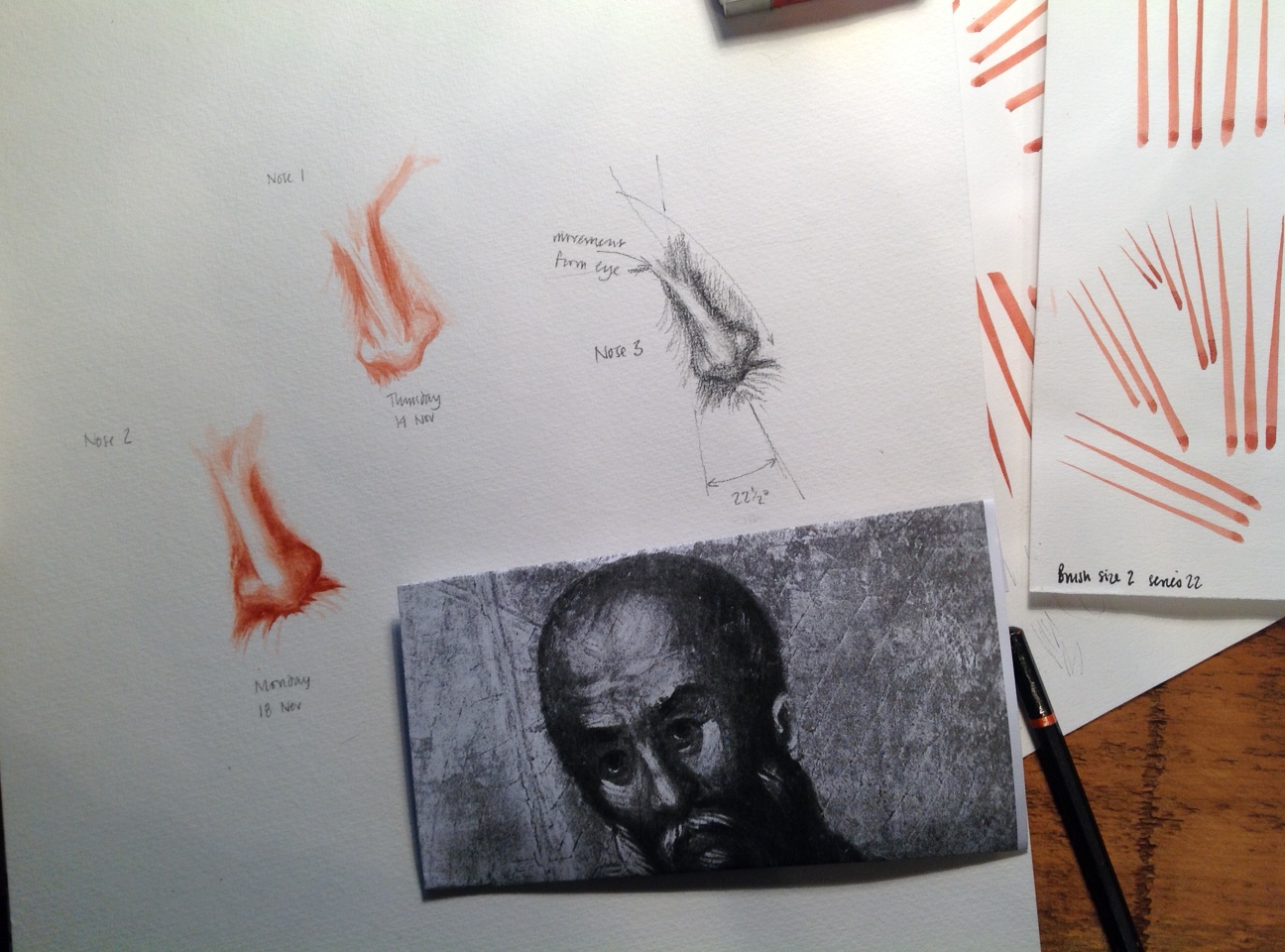
It’s Monday 18th November and I am going to get into the rhythm with some brush strokes. Then, I am going to try the ‘Drawing on the Right Side of the Brain‘ tip and turn St John upside down and begin a study of his nose.

nose study one

One of my fellow students, who paints exquisitely, explained that she builds up in very light layers using the finest of lines and very little paint on the brush. She leaves the pure white of the paper as highlights. Once she has established the form, only then does she begin to apply the darker strokes.

There should always be plenty of scrap paper below your palette to test your brush lines after each dip in the paint.

Second attempt at the nose

Second attempt at the nose

Well, looking at the nose upside down certainly helped. It is an improvement on nose 1 a few days ago. However, I have not caught the true shape of the highlights of where the nose bowl widens.  I have also missed the movement of the nose which very gradually curves from his brow on the saint’s right side. All these things become much more evident when you take a step back and look from a bit of a distance.

I am going to try a pencil study next to try and get a grip of the structure. Some days I just don’t have a full hour to set aside for icon practice so what I will do is more ten minute pencil studies of various parts of the face.

Work out the highlights by tracing over the shapes to identify the key pools of light and dark

Work out the highlights by tracing over the shapes to identify the key pools of light and dark

Pencil study of the nose

Pencil study of the nose

That’s enough of my holy noses, it’s time for morning coffee!

Thanks for reading and thank you God that I can share this with you today. All the best with your own icon practice.

Love Ronnie

BOOK SUGGESTION

Aidan recommended a book for us.  It is an American book and if you haven’t already got it, it is a treat for your Christmas wish list. It is a chunky book, paperback and has lots of good quality colour plates. Here are the links:

http://www.amazon.co.uk/gp/offer-listing/1588391140/ref=sr_1_1_olp?s=books&ie=UTF8&qid=1383298414&sr=1-1&keywords=byzantium+faith+and+power&condition=new

http://www.amazon.com/Byzantium-Metropolitan-Museum-Art-York/dp/1588391140/ref=sr_1_2?ie=UTF8&qid=1384766362&sr=8-2&keywords=Byzantium%3A+Faith+and+Power+%281261-1557%29+%28Paperback%29

Book cover image.

Good Intentions

It’s been over a week of good intentions but I have not settled down properly to brush practice until today. Norman has arrived, three months old and so full of beans that whatever I try to do, he wants to do it better. There’s been little in the way of stillness with our new three pet dynamic at loggerheads. I’ve been asking for help from St Frances, but I think he is enjoying the entertainment too much.

On top of this, my first exhibition at Newcastle-under-Lyme library, for ‘Drawing the Street‘ has been quite a hit. ‘Seeing with the eye of the heart’ applies to our wider surroundings too and it is wonderful that people are starting to look at their town with renewed interest. 

For those who are interested in the icon course content, I am going to see if I can upload a pdf of my notes. If they don’t appear on this blog and you would like a copy, please get in touch with me and I will send a pdf over to you.

28 Oct 13 Day 1 29 Oct 13 Day 2 30th Oct Day 3

I have been practising brush strokes, with one or two which came out ok but more practice required on the exit part of the stroke. We are aiming at being able to complete a hundred or so consistently even calligraphic lines, straight, curved and diminishing, all in one go. 

Brush stroke practice

Brush stroke practice

We have four monochrome studies to complete. This is proving much harder to do than I thought. We all made great progress at Moele Brace, no distractions and fellow students supporting one another, but home life however is another matter. 

Norman

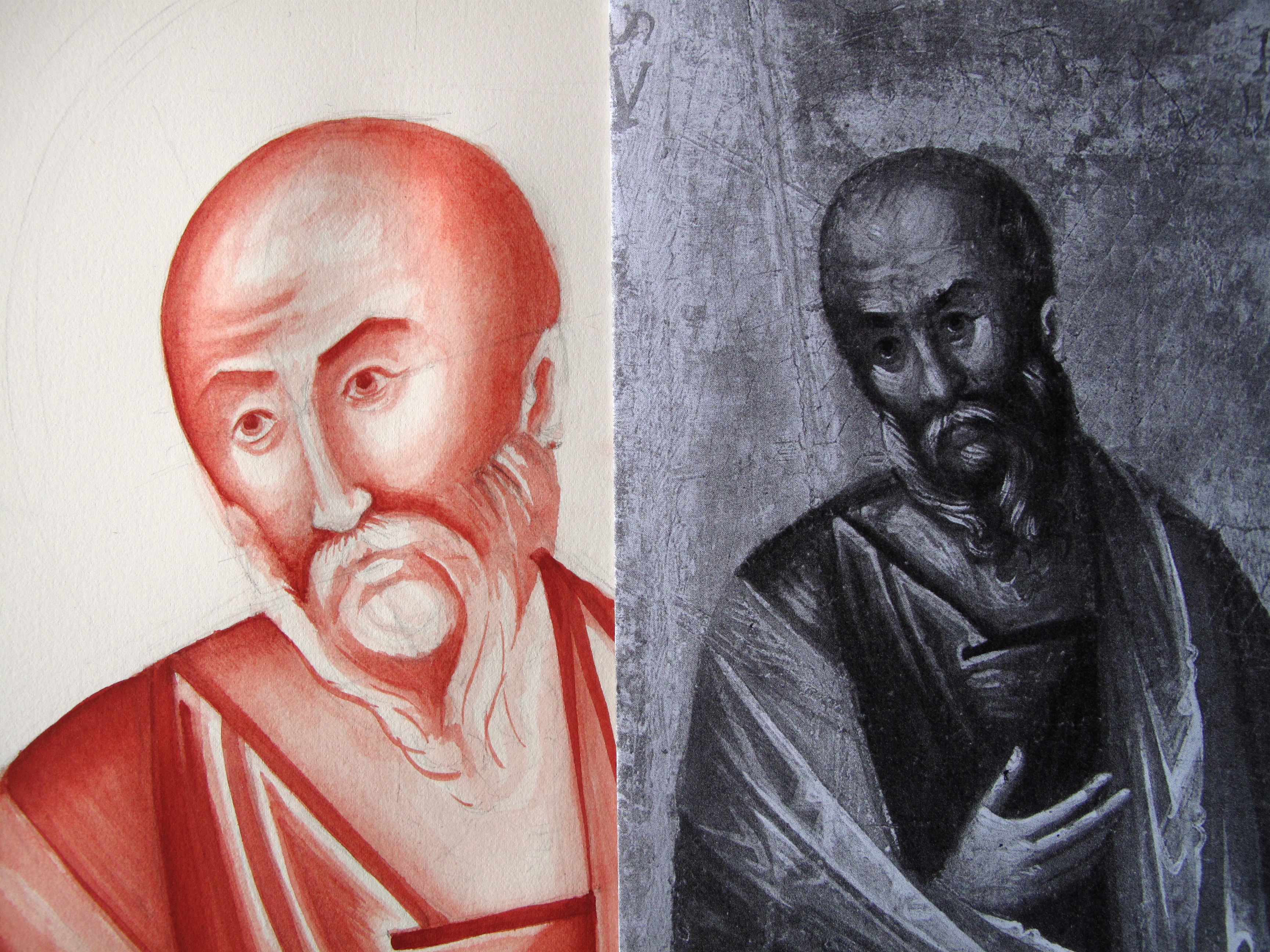
I have made a start on St John, which is taken from that compellingly beautiful and moving icon “the Holy Virgin Kataphigi (Refuge) and St John the Theologian” which came from the Poganovo monastery c1395. I am starting early with my practice on this as I would love to have this as one of my finished pieces.  As you will see from my efforts below, I have a long way to go. That’s ok, I am looking forward to watching things unfold from these early hesitant efforts. 

St John in rough pastel sketch

St John in rough pastel sketch

As a warm up, I did a rough pastel sketch. Looking at it a little later I could see St John’s face was too wide, the tilt of his head up a little too far. A helpful exercise though. Please ignore my messy strokes, I did this quickly to try and get a feel for the proportions. 

I then did a rough sketch in red earth light tempera wash to establish the structure. Again, it’s not quite right, but I will keep at it. I hope that in my next post, there will be a little more progress. I have also got to get better with my brush strokes. 

St John, first wash in very dilute egg tempera

St John, first wash in very dilute egg tempera

Thats all for now. Thanks for reading and all the best with your own icon studies. R

A Stormy Start

Tomorrow, on the feast of St Jude and St Simon, twelve students will gather to begin our three year icon diploma course, run by Aidan Hart in the Trinity Centre at Moele Brace, Shrewsbury. We will be learning about the traditions of icon paintings, the theology, the methods and materials before painting our own icons which will go on display at the PSTA in Autumn 2016.  

Some of the students are travelling quite a distance – from Germany, Dublin and another from Brighton. This is such a privilege to be part of this group and so I would like to share some of my experience through this blog. 

It looks like we will have a choppy start as there is an amber alert for a fierce storm on its way from the Atlantic, nick-named St Jude. I wish my fellow students all a safe journey and look forward to meeting them and trust that the patron saint of lost causes will guide us through the days ahead.