Icon Diploma Student

Learning to see with the eye of the heart

Archive for ‘May, 2015’

Three days on a Triptych

icon class

Icon Diploma Students taken at Aidan Hart’s May session 2015

Hello icon friends and class mates,

I’m just back from a three day intensive painting our standing/seated figures. I brought my gilded triptych centre panel already prepared with the image transferred so I could start to paint in class.
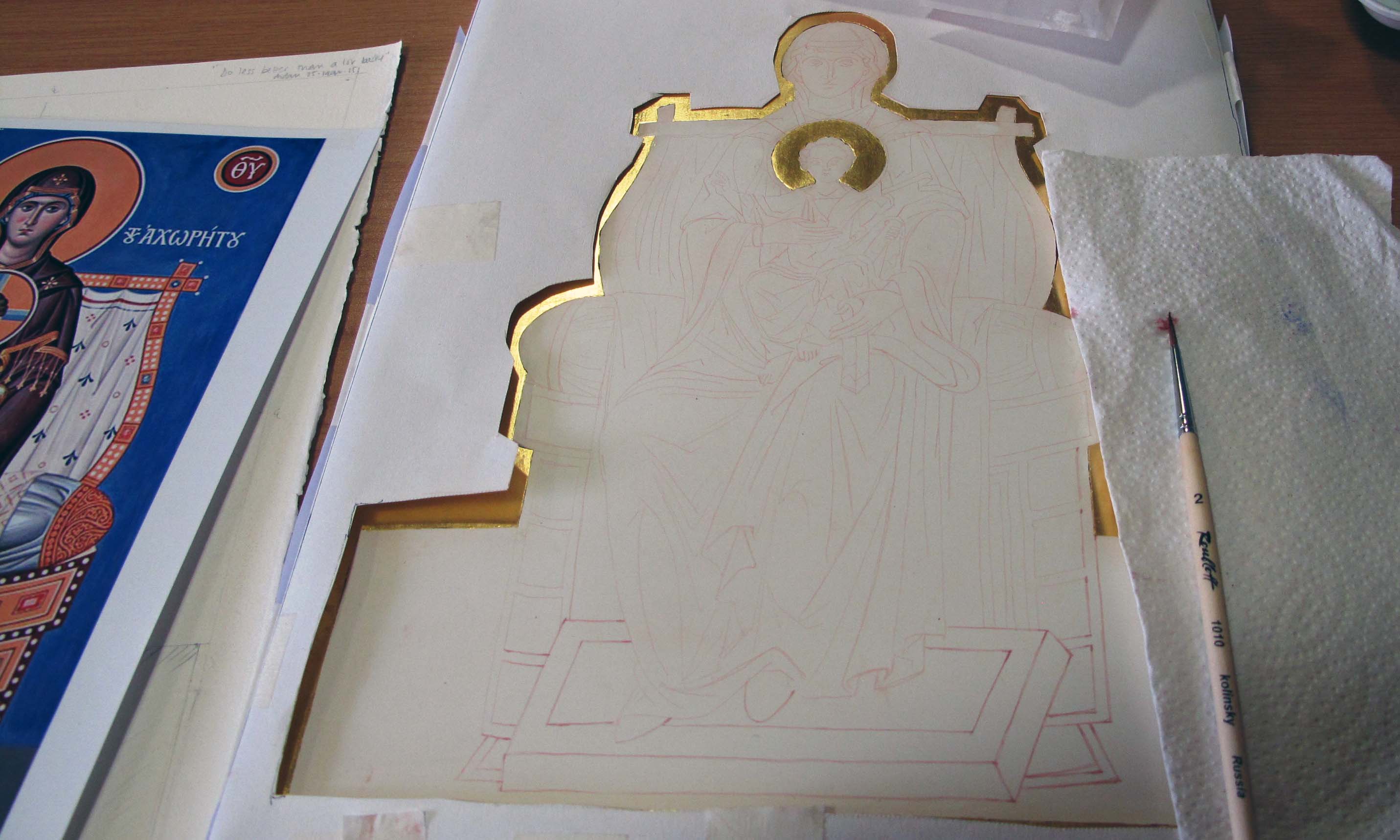
icon outline drawing

Transferring outline on to gessoed panel

Just to rewind a little, I photocopied my drawing on to tracing paper to locate the outline prior to water gilding. After gilding, I rubbed red ochre pigment into the back of the tracing paper/drawing itself (rather than using an intermediary sheet), and using a fine propelling pencil with a fairly hard lead, transferred the image on to the board.
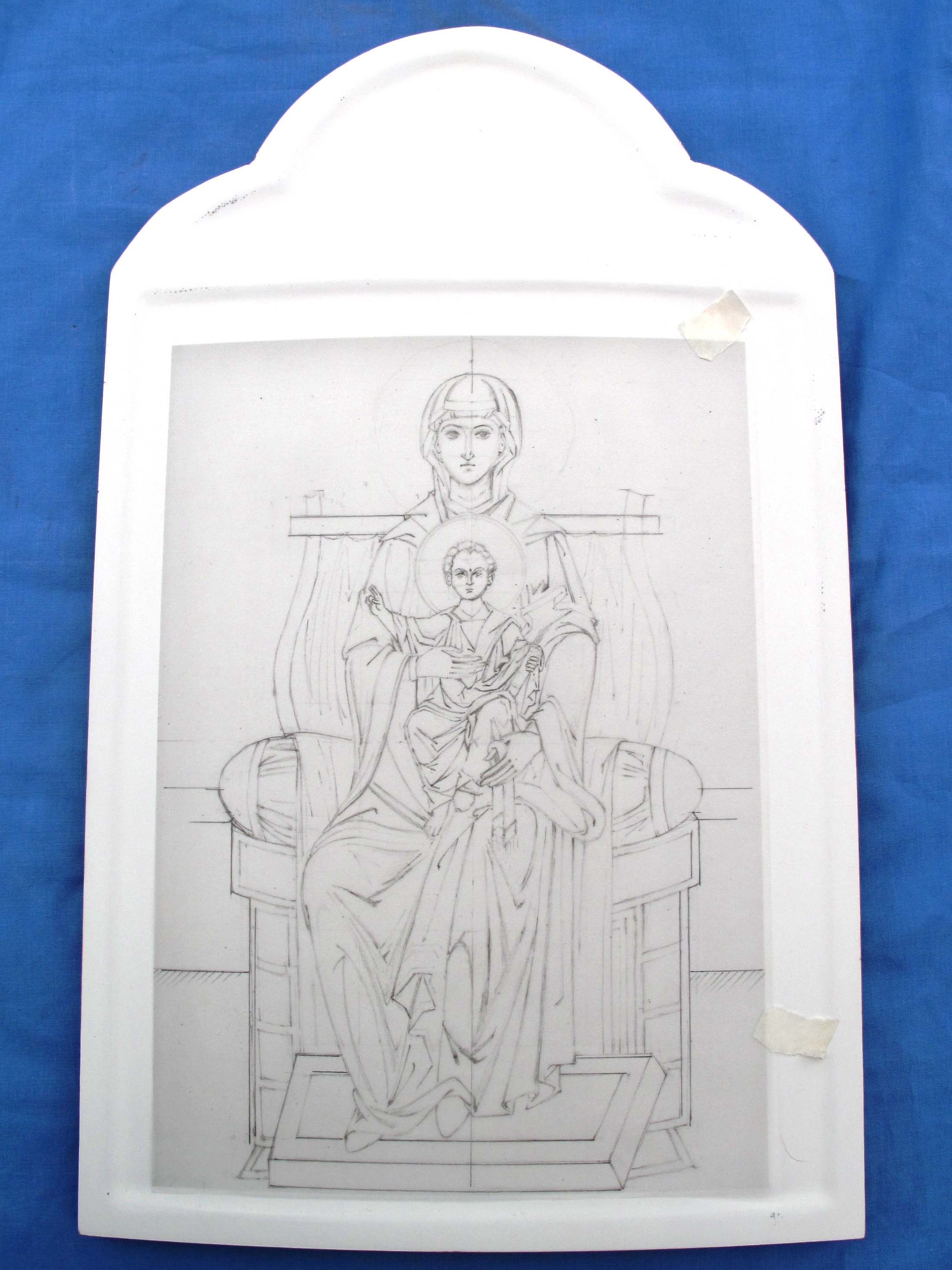
tracing paper drawing

Drawing of icon on tracing paper

Once all the main lines were transferred on to the board, a weak mix of pigment fixed the lines in place. I then began the underpainting and modelling of the garments.

underpainting icon

First stage of underpainting

Aidan suggested that I used Red Ochre for the Blessed Virgin’s upper garment as it has some blue in it. I also used Lapiz Lazuli Dark, a beautiful natural blue and Ivory Black to deepen both colours; all pigments are from Cornelissen’s.
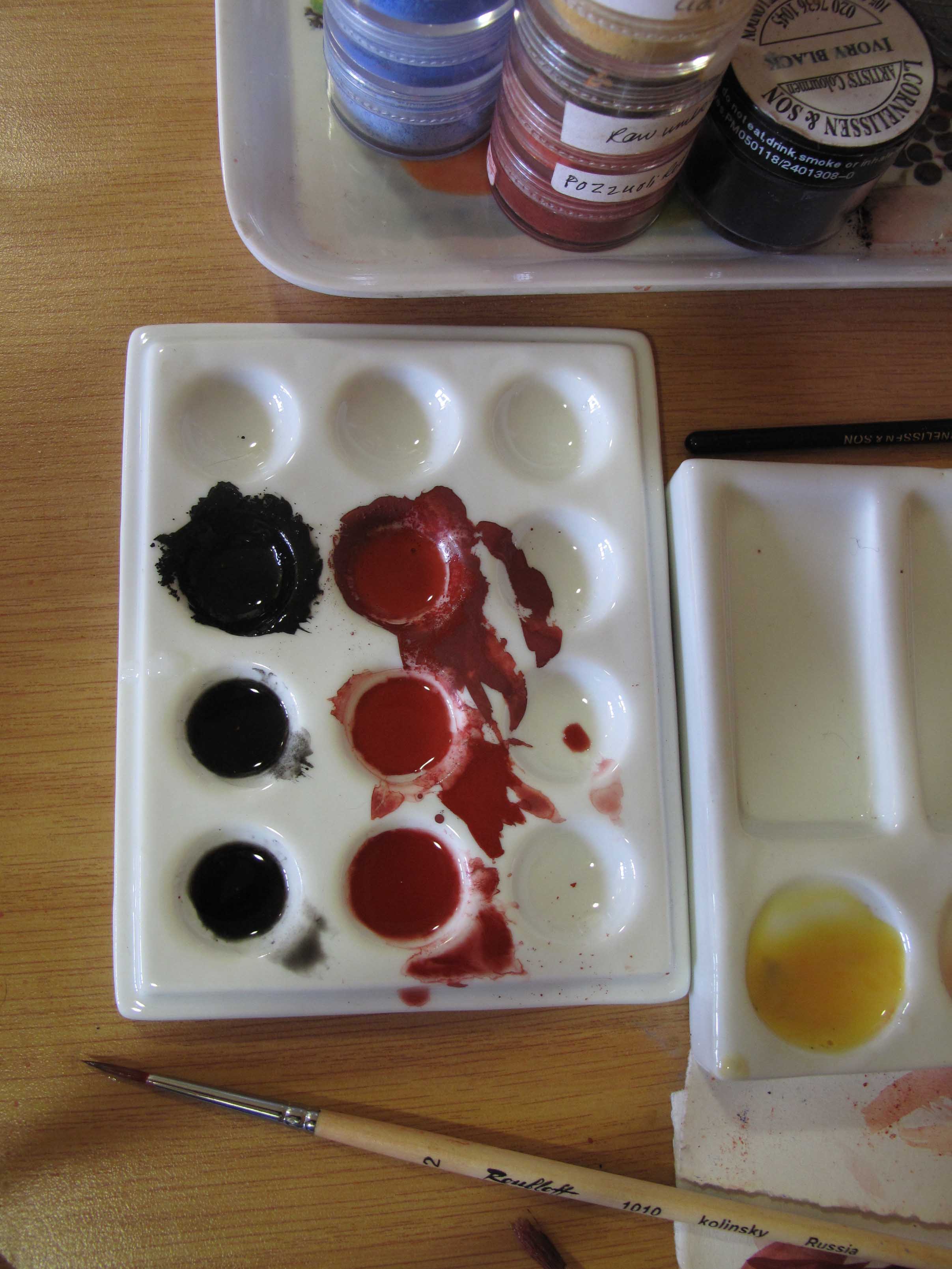
ivory black and red ochre

Ivory black and Red Ochre pigments

Both pigments are very strong so I mixed them up separately first, then blended. For the underpainting I used a lovely size 2 Roubloff 1010 kolinsky sable brush which I had recently ordered from Vesta-k. It has a really sharp point and holds the pigment well.
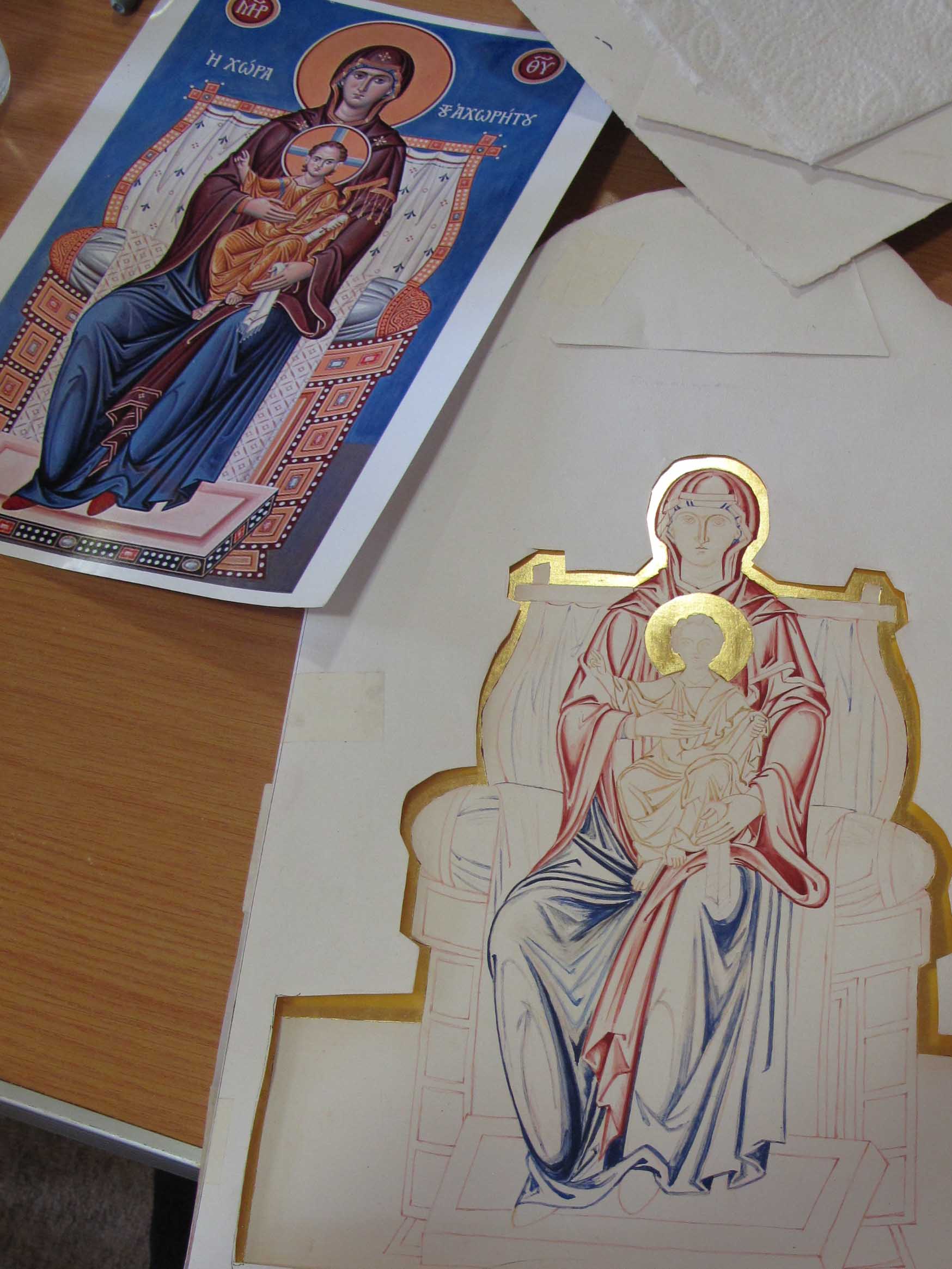
underpainting garments

Building up the underpainting of the garments

I mixed black to the lapiz lazuli and red ochre in varying degrees to give depth to the underpainting. The deeper shadows are painted using a lot of black in the mix.

lapiz lazuli

First layer of membrane applied using a wash of pure Lapiz lazuli over the underpainting.

membranes on icon

Membranes on the garments

Pure red ochre and lapiz membranes washed over the underpainting with a very thin layer of lapiz washed over the red afterwards to unite the garments.

After several layers of membrane, I applied a nourishing layer of 20% egg 80% water and let it dry before going over the shadows and adding highlights. Aidan suggested fine layers of pure white dry-brushed over the membrane to give translucent layers of highlights.

The underpainting of the Christ Child is in English Yellow Ochre with a little Red Ochre added to model the form. The colours are painted quite densely as the garments will be gilded using shell gold assist. I understand from my class mate Lee that for the crispest, most gleaming gold lines, hand-made shell gold is the way to go – thanks Lee! Watch this space for adventures in making shell gold – I rang Wrights of Lymm for a couple of books of gold today!

three days work

Three days work

Thanks for reading.

Ronnie
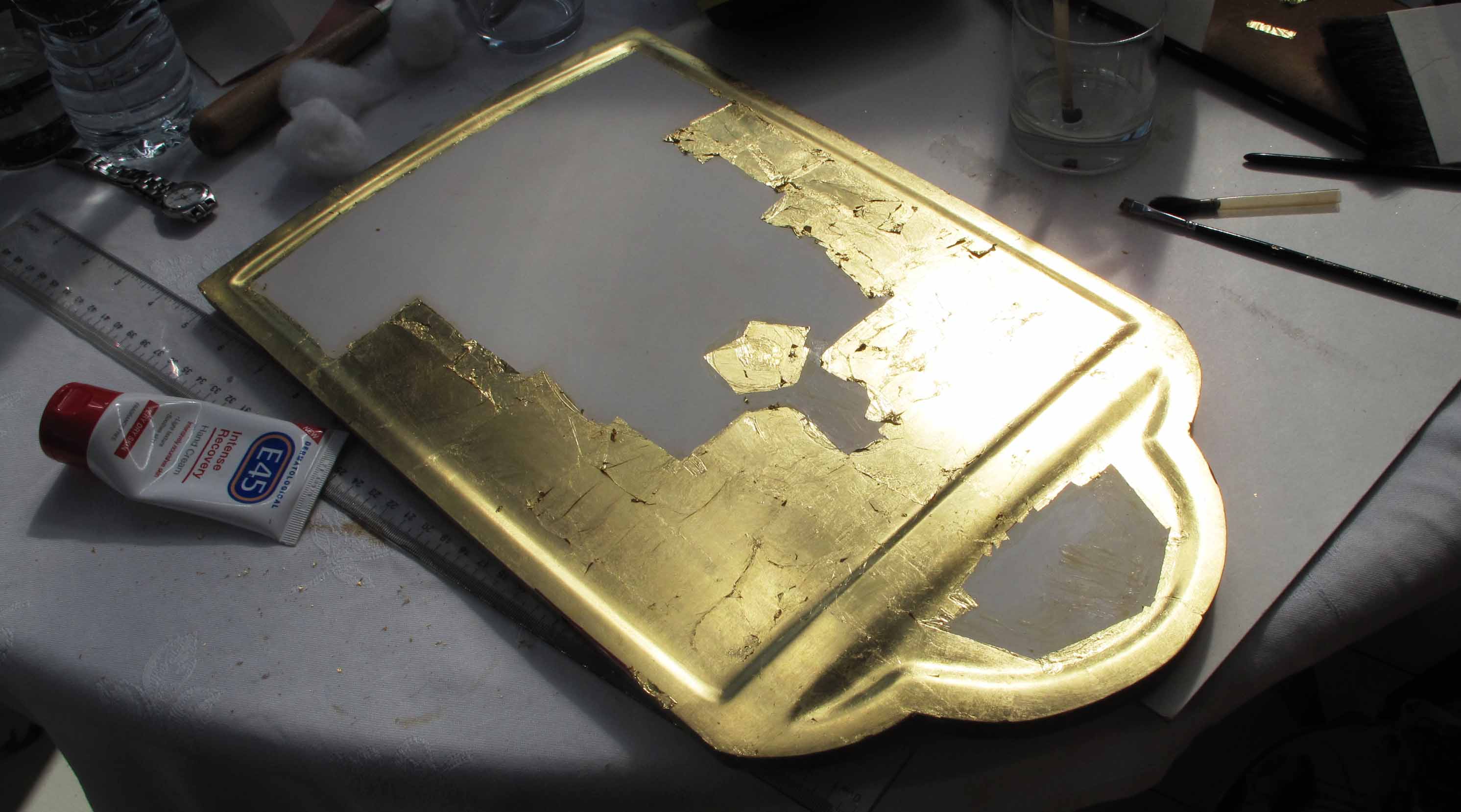
Gilding the Triptych

gilding a triptcyh

Gilding a triptych

I’d like to share a few thoughts following my attempts to water gild the triptych. It’s Spring here in UK and I love the lighter days and milder weather. I opted to work in the conservatory for the even light and to be immersed in the burst of new green in the garden.  I often have cold hands so the warmth in here is wonderful for loosening up my fingers ready for gilding. It’s better to gild in cool, damp weather but I thought I might just get away with it being mild – nope, I didnt! So here is my first tip: if gilding a large area in warmer weather, do it in two or three stages as the bole dries out so quickly. You need time to burnish the gold whilst the bole is still relatively soft soon after double gilding. With hindsight, I should have gilded and burnished all the raised areas as one complete area first, then gilded and burnished all the flat areas afterwards.

raised border gilding

Gilding the Kivotos

Masking out the gesso was helpful as carefully scraping the gold off the gesso after gilding can take an hour or so. For the fiddly areas, I used a sharp scalpel to score along the edges in the same way as I did with the bole (See previous post). The other thing which helped was thirteen layers of bole. These were just enough to cover the tiny air holes in the gesso and the patches of scrim which had shown through. If you are about to gild, then I can recommend Aidan Hart’s class demonstration video clip here on You Tube.

gilding a door to the icon triptych

Double gilding over the first layer of loose gold on one of the doors

Masking fluid saves time scraping gold from gesso

Masking fluid saves time scraping gold from gesso

gilding kit

Some ingredients for gilding – cat drinking the water for brush-cleaning is optional!

A phone (switched off) makes a handy 10mm/half inch prop to lift the icon board so the water flows away from previously gilded areas. Hand cream is useful to rub on the back of your hand before brushing the squirrel tip across – this helps the gold leaf stick to the tip. Vodka is added to the gilding mix together with Buxton water (PH neutral). I used gold leaf, 23 and 3/4 carat loose, extra thick from Wrights of Lymm, Cheshire. The small jar contains size prepared from rabbit skin glue granules. Other gilding kit consists of a squirrel mop ( the large brush to the top right), a gilder’s cushion and gilder’s knife to cut the gold leaf. Having a cat in the midst is not ideal as hairs blow into the mix. However, at the moment our cat is still out-of-sorts having recently lost her companion and won’t settle unless she has company nearby. If you are about to water gild an icon – here is our class crib sheet of Gilders’ Tips which may help.

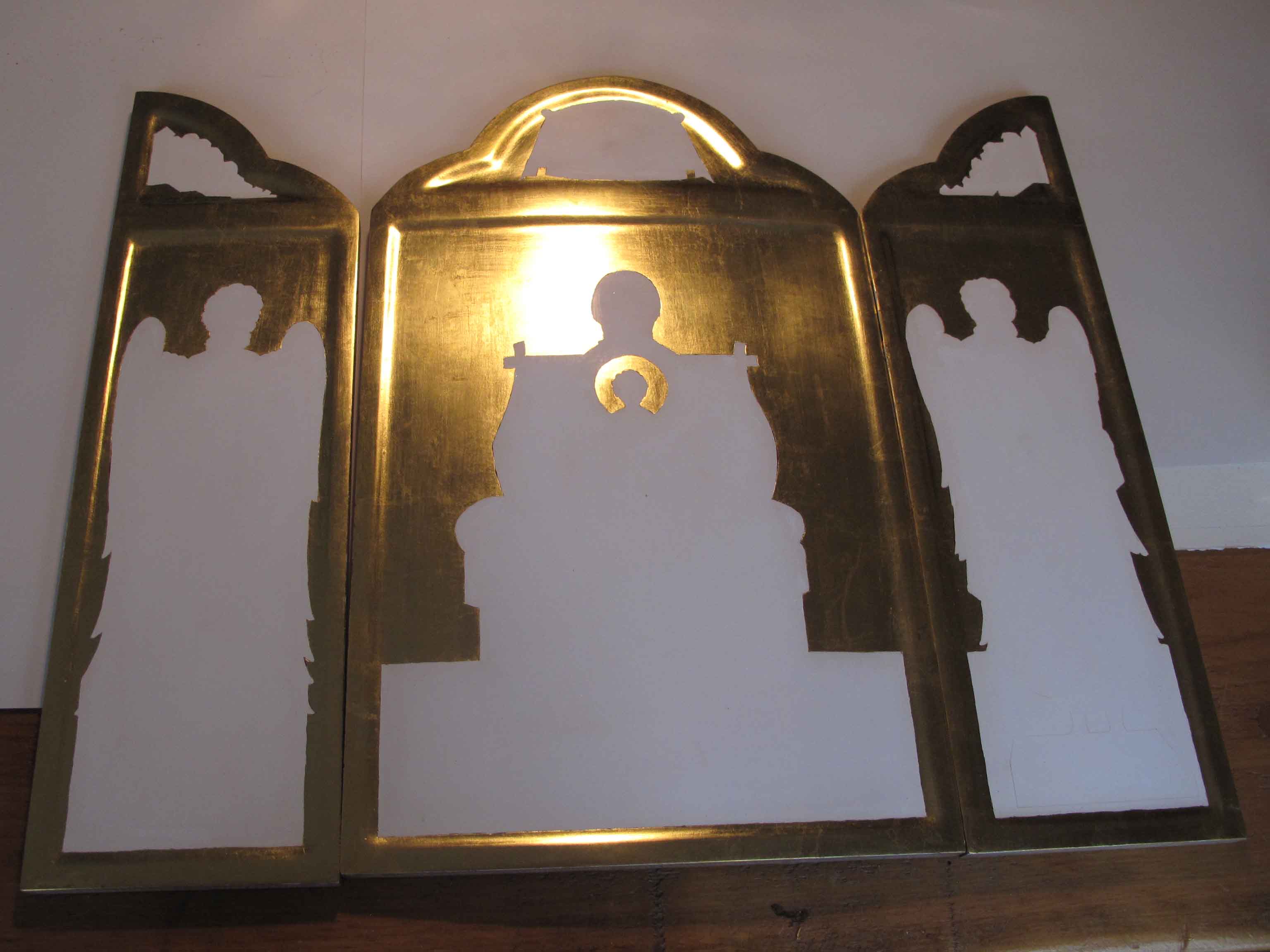
Gilding complete

Gilding complete

This actually looks a lot better than it does in real life but I am glad the gilding is done. Some parts are smooth, some pretty rough in spite of a solid week’s work. Here’s a close-up on the burnishing marks as a result of letting it dry out too much:

Burnishing marks

Burnishing marks

Once again, thanks for reading and all the best with your own endeavours. Ronnie

Triptych begins

Bole and water gilding a triptych

Gilding a Triptych

Hello Icon Friends,

I’ve begun work on a triptych for my sister Anne, in Australia. She made a lighthearted requests some 7 or 8 years ago, saying how much she would love to have one of those icons that ‘open out’. I never forgot her wish and it was wonderful when Aidan confirmed that standing and seated figures were part of the curriculum so my triptych could be included in the course work.

triptych treated with cuprinol

Treating the oak with Cuprinol

Dylan Hartley, in Ironbridge hand-made the quarter-sawn oak panels and gessoed them ready for me to sand. With the great benefit of hindsight, I should have asked him to treat them with Cuprinol in the workshop so they could be covered evenly on all sides – but it was only when I thought about posting the boards to Australia that I realised they would need to be treated due to their strict import regulations. A few days after I had applied the treatment and varnished the oak, the boards warped but the gesso was unharmed – no cracks.

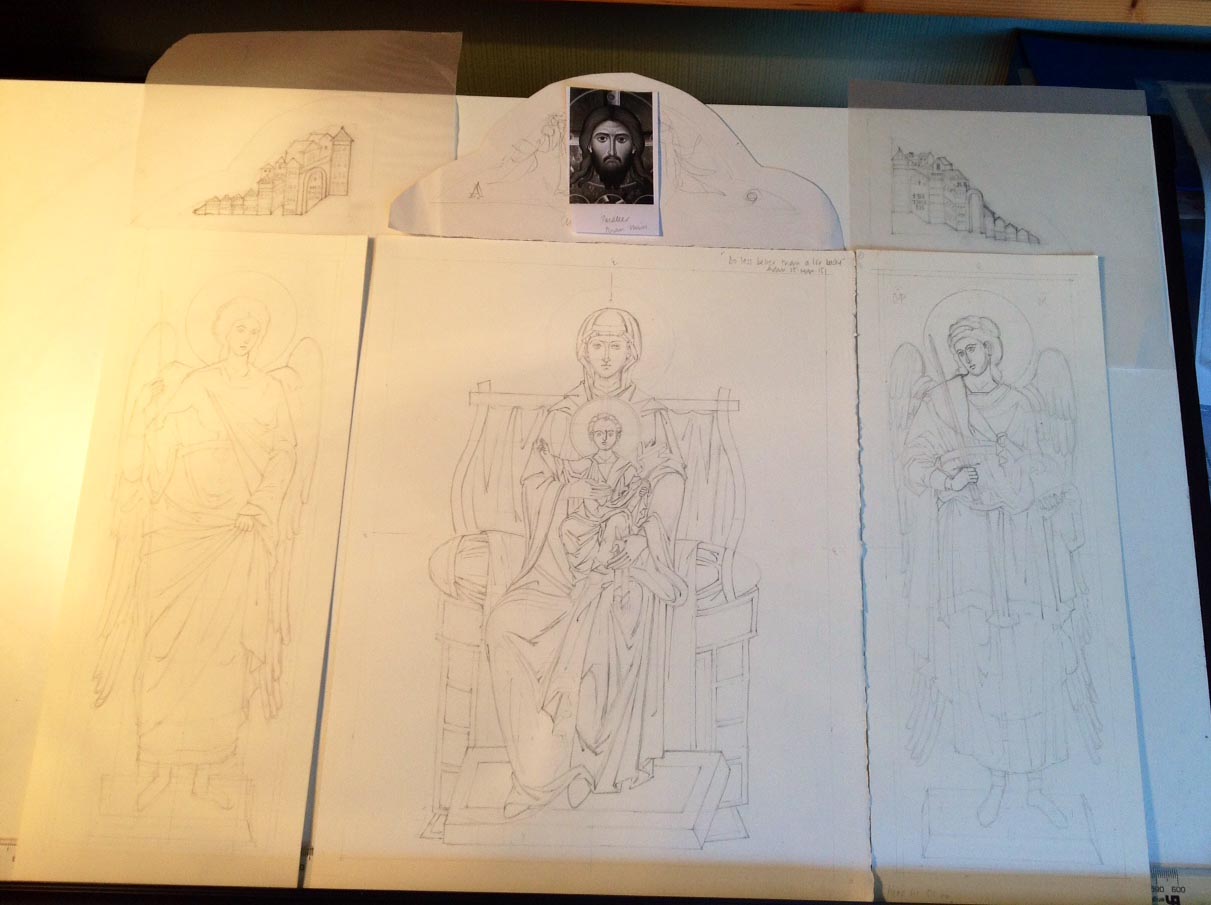
sketch drawings for triptych

Planning the triptych layout: Upper panels include the Holy Face in the Mandilion, with Bethlehem and the New Jerusalem either side.

Anne had told me what she had in mind for this triptych: Arhcangel Raphael (the Shining One who Heals) and Archangel Michael, the Warrior, either side of the Blessed Virgin and Child. Aidan introduced me to the magnificent angels of Chora to adapt to fit the side panels – the original wall paintings fit in tapered panels set within a domed ceiling.

angel of chora

Detail of one of the Angels of Chora

Next stage was to prepare the gessoed panels by sanding in sequence through the grades of sandpaper from 80 grit to 1200 grit to prepare for water gilding. it took the best part of three full days to sand and bole the boards ready for gilding.

sanding the gesso

Sanding off the scratches and bumps in the gesso

sanding gesso

Sanding back too far

With all the irregular surfaces and curves covered in gesso, it was difficult to sand back enough to articulate the shapes without also revealing some of the linen scrim. As soon as I saw the scrim, I avoided the area and only smoothed it with the finer grades of sandpaper. It eventually covered (almost) under 13 layers of bole.

bole on triptych

Bole applied to triptych

It is very fiddly to apply layers of bole around narrow spaces so this time I masked the whole area out with masking fluid with a little added pigment.

masking gesso

Masking out the gesso before applying the bole

Before removing the masking fluid, I scored the edges to avoid lifting the bole.

Removing masking fluid

Removing masking fluid by scoring a clean edge with a sharp blade.

More on gilding in the next post – with a few tips on what not to do!

Thanks for reading,

Ronnie